Tuesday, 26 November 2013

26 - Great Blogs and Podcasts


As my limited run as a horror blogger nears the end, here’s a few other horror-related blogs you might like to peruse, and a couple of entertaining podcasts for good measure. See how I take care of (both) my readers?

 
http://www.freddyinspace.com/ - Freddy In Space. Infrequently updated now he writes for Fearnet, but there’s a decent archive to wade through. Despite the name and the entry chosen below, this isn’t all-Freddy or even all-slasher.

Sample entry:  http://www.freddyinspace.com/2013/06/a-closer-look-at-freddy-kruegers.html - A Closer Look at Freddy Krueger’s Prototype Gloves

 
http://finalgirl.blogspot.co.uk/ - Final Girl. Another pro-slasher, all horror blog. She vanished for a little while, then she unvarnished and stuff.


http://retroslashers.net/ - Retro Slashers. Not updated anywhere near frequently enough for me, this site’s still worth a browse.

Sample entry: http://retroslashers.net/misleading-slasher-trailers/ - Misleading slasher trailers


http://www.hudsonlee.com/ - Vegan Voorhees. The most frequently updated site out of all my choices, and probably my favourite one, not least for the massive amounts of Jason-love shown.

Sample entry: http://www.hudsonlee.com/13-things-to-love-about-friday-the-13th/ - 13 things to love about Friday the 13th


http://the-bodycount-continues.com/main/viewpage.php?page_id=1 – The Hysteria Continues podcast. The combined forces of The Bodycount Continues horror message board and the Hysteria Lives website (home of Justin Kerswell, author of Teenage Wasteland) bring you an informative and often ludicrously silly guide to slashers, gialli, proto-slashers and more. Innuendo-laden fun awaits.


http://geeknation.com/podcast/the-movie-crypt/ - The Movie Crypt with Green & Lynch. Hosted by Adam (Hatchet) Green and Joe (Wrong Turn 2) Lynch, this is a great show for horror fans and anyone with an interest in making films. Most episodes have a special guest from the world of horror, not just actors but writers, directors, make-up effects artists, costumers and more.  OK, so a lot of them are people who Green and/or Lynch have worked with, but why not get your buddies in?


http://www.talkshoe.com/talkshoe/web/talkCast.jsp?masterId=99734&cmd=tc – Castle of Horror. Speaking of buddies, I’d be a bad friend if I didn’t mention the podcast my old chum Drew Edwards works on with some other people.

No direct links to shows for this one, but try their An American Werewolf in London episode.

Monday, 25 November 2013

25 - The Ultimate Portmanteau Movie


THE FOLLOWING ENTRY IS REVISED AND EXPANDED FROM TWITTER POSTS MADE AGES AGO.

I love a good portmanteau horror anthology movie, especially the Amicus films of the early seventies, but they’re often let down by a flawed entry. Imagine if one could pick and mix to make one’s own dream portmanteau movie.

 
This is mine. Call it “Tales of Witless Madness” or “Vault of the Crypt”. I gave myself the rules of using only five stories, only adding one story from each film, using British movies and opening and closing with opening and closing stories only. Once I’ve “cast” my dream anthology, I’ll give you the ingredients for the slightly inferior sequel.


We start with the Mr Tiger story from Tales That Witness Madness, a film from World Film Services which is often mistaken for an Amicus production – though as it’s directed by Freddie Francis who directed three Amicus portmanteau films, is set in an asylum like Amicus’ Asylum, and features Joan Collins and Donald Pleasence who both appeared in Amicus films, it’s an easy mistake to make. Mr Tiger is the story of young Paul and his new friend – an “imaginary” tiger. Shades of Calvin & Hobbes, with an obvious but fun twist.

 
Then there’s The Neat Job from The Vault of Horror, which was Amicus’ second EC Comics inspired film. It’s not as good as Tales from the Crypt, and falls down after the first two stories. It's one of those wonderful little "just desserts" ironic death stories where a neat freak husband belittles his wife over her inability to keep the house as clean as he wants... until one day she decides she’s had enough and takes her revenge.
  
Next would be Lucy Comes to Stay from Asylum, which has a couple of good stories and a pretty solid linking thread, but falls apart near the end. Released from an asylum, Barbara is looked after her brother and a nurse who are both very strict. Then she gets a visit from her playful friend Lucy, who has mischief in mind.


The daddy of the British portmanteau horror film is Dead of Night. Not every chapter holds up nowadays, but the acknowledged classic is The Ventriloquist’s Dummy. It’s not the first story to use a mad ventriloquist who thinks his dummy is alive, but it does tell the story well. 


 Finally, we have Blind Alleys from Tales from the Crypt. Probably the strongest overall of any of the films chosen here, Tales... has three solid stories and a couple of passable ones. This one may well be the best. A miserly man takes over as director of a home for the blind, mistreating the residents and making financial cuts so he can buy the finer things in life for himself and his dog. Then the surprisingly efficient blind craftsmen take their revenge, and if you thought the corridor lined with razor blades in the picture above looked scary, you ain't seen nothin' yet...


Those are my favourites, but what about the runners up? Well I’d have to start with ...And All Through the House from Tales from the Crypt. Joan Collins kills her husband on Christmas Eve, and has to clear up the mess. An escaped madman dressed as Santa lurks outside, but she can’t call the police until she’s got rid of the body. Remade for the Tales... TV series, this is the superior version.

Also, I love seventies horror Joan Collins. So much better than eighties soap star Joan Collins. 


After that, probably Frozen Fear from Asylum. The image of dismembered body parts wrapped in paper and still crawling on is one that sticks with you. Then from Tales That Witness Madness we could have had Mel, where Michael Jayston cheats on Joan Collins with a tree, because of course he does. It’s better than Mr Steinway from Torture Garden, the story of a jealous piano.


Next I would have picked An Act of Kindness from From Beyond the Grave. I think this is a stronger film overall than Tales from the Crypt, but none of the stories have quite the punch of Blind Alleys or ...And All Through the House. An Act of Kindness features the wonderful pairing of Donald Pleasence and his curiously attractive daughter Angela in a strange story of love and betrayal.

 
Finding a second ending is tough, because most of these films fall down by the last chapter. The best option is probably The Cloak from The House That Dripped Blood, a vampire story with Jon Pertwee, Geoffrey Bayldon and Ingrid Pitt. 

And there you go. Seek out these films, and try to assemble your own movie.

Or don't, it's your call. You're probably busy. 


Sunday, 24 November 2013

24 - Horror Comics


Horror in comics weekend concludes with a brief summary of some other horror titles I have enjoyed. I’m looking for recommendations of other good horror comics, so any suggestions are greatly appreciated.


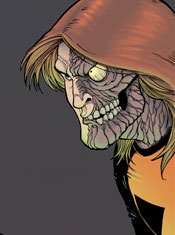
I’d better start with the one I know best – Halloween Man. For over ten years I’ve been the editor of this ongoing webcomic, which has just been snapped up by Monsterverse Comics. I can’t really be impartial about it, but when the first Monsterverse stuff comes out next year you really should check it out.


A few years ago there was a run of Halloween books from Devil’s Due comics, written by Stefan Hutchinson. There was a miniseries (Nightdance), the anniversary book Halloween: 30 Years of Terror and then another miniseries (The First Death of Laurie Strode) which aimed to bridge the gap between Halloween II and Halloween H20. Unfortunately, for awkward and confusing reasons the miniseries was never completed. A quick search through online retailers or an actual comic book store is worth your while to track these down, Hutchinson manages to capture something more in line with the “trilogy” than the other films in the series.


Alan Moore’s Swamp Thing is still very highly regarded, and with very good reason. The short version is that Moore took over a lower-tier title, wrote a single issue clearing the decks and then stripped the character down and rebuilt him from the ground up. Over the course of 44 issues, Moore pretty much created the blueprint for modern horror comics – without Swamp Thing, no Hellblazer. Without Hellblazer, no Sandman. Without Hellblazer and Sandman, no Vertigo.

Before Moore, Swamp Thing was a title about a scientist named Alec Holland who had been turned into a plant being through an explosion of comic book science. The overall plot was about Holland’s quest to regain his humanity. Moore spun that around so that Holland had died in the explosion, which led to his consciousness being absorbed into a plant elemental. Knowing he was dead and would never again be human led Holland to explore his life as a plant elemental and the new abilities that gave him.


Moore’s run deals with multiple forms of horror. There’s a lot of magic, demonology and possession, but also vampires, zombies, werewolves, ghosts, radioactive mutants and more. The key element that raises these stories above the mainstream is how Moore wraps these stories in real life horror – interweaving them with stories of abused wives and children, slavery, incest, shootings, alcoholism, environmental destruction and serial killers until they become one. In clumsier hands these could have been cliche-filled messes, but Alan Moore’s hands are steady. Forget Watchmen, this is his best work at DC.


Unsurprisingly, one of the supporting characters from Moore’s run was given his own book. Unfortunately, the perfect title had already been taken by a Clive Barker film, and so John Constantine had to settle for the essentially meaningless Hellblazer. Constantine was a chain-smoking Liverpudlian con-man, occult detective and magic user who had appeared in Swamp Thing as something approximating a tour guide to the dark magical underbelly of America and beyond, with a greater understanding of who Swamp Thing was than he himself had at the time. His solo title followed his “adventures” after he returned home.

The book originated under Jamie Delano, but it’s the work of later writers I want to bring up here. Issues 25 and 26 from during Delano’s run are a fill-in by Grant Morrison and mix mass insanity, British cultural tradition and anti-nuclear-weapon concerns to terrifying effect. This is still one of my favourite Hellblazer stories ever, and definitely one of the most frightening. After Delano came Garth Ennis, and it’s his run on the book I followed the most closely.


Ennis told stories of ordinary horror, giving John lung cancer in his first storyline before mixing the machinations of heaven and hell with British politics and race relations, vampirism with homelessness and more. He blended these stories in a completely different way to Moore, but the effect was the same – the scares came from both sides of the reality curtain, and merged to become greater than the sum of their parts.

I really need to explore more post-Ennis Hellblazer. I’ve picked up the odd collection here and there, but they’ve never really grabbed me quite the same way.

 
Neil Gaiman’s Sandman started out as more of a horror title, before opening out into all aspects of the fantastic through fairytales, myths and magic and beyond. But the horror never quite went away, lasting right through to the end.

Sandman, for those who have never picked up a copy, is about Dream, who is both the lord of dreams and an anthromporphised personification of dreams, stories and all that is outside of reality. A very basic summation of the overall plot by Gaiman is "The Lord of Dreams learns that one must change or die, and makes his decision."

The purest horror stories occur in the first two volumes – in the first volume, Preludes and Nocturnes we have the story 24 Hours, which deals with the gradual mental breakdown of the population of a diner thanks to the manipulation of an old DC comics supervillain named Doctor Destiny who stops them from leaving. Supernaturally warped cabin fever follows, leading to violence, sex and soul-baring. In the end, despite the outside mystical influence this is just a story about a group of people going insane.

The other great horror story from Sandman is called Collectors. If serial killers are your thing, this one is for you. Under the punning guise of a cereal convention, serial killers from all across America gather for a convention in a hotel in Georgia. Over the course of a single issue, Gaiman burns through enough serial killers for a bookshelf of Thomas Harris imitators and each one is terrifyingly believable. Then he ends by destroying their mythic power – Dream makes them realise the truth behind the fictions they have built up in their own minds about them being mighty hunters and figures of greatness, and they shuffle out, broken.


Finally, we find the biggest title in American comics at the moment – Robert Kirkman and Charlie Adlard’s zombie apocalypse epic The Walking Dead. I’m way behind on this one as I’m reading it in the massive 48 issue compendium editions, and I’ve only finished the first volume so I’ll keep my thoughts brief.

I gave up on the TV version quite quickly, but I may have to give it another chance. I’ve enjoyed the comic book series so far, although it’s incredibly bleak – I’m almost 100 issues in, and I’m wondering just how Rick hasn’t just snapped and put a gun in his mouth by now. He meets some new people, a few of them die, a few of his friends die, and the survivors march on. Repeat to fade. 

 
Even in black and white, Adlard’s zombies are the equal of anything TV or movies have given us, with accompanying gore to match. I’m not surprised that this title is a success but just how much of a success is mind-blowing. This is from a few months ago, but...

Well, in the full BookScan list, there are forty-two books listed with "TWD" (including the $100 boxed hardcovers, or the book of just the covers, and so on), summing up to almost 685k copies all together -- almost 7% of all comics total sold to BookScan reporters. In dollars? A staggering $20.5 million dollars, which means that, hang on to your hats, nearly one dollar of comics in eight that was sold by a BookScan reporter went to "The Walking Dead." One in eight, that's insane!

What that means is "TWD," all by itself, is the #3 largest publisher on BookScan. Or, to put it another way, this single title sold more than the collective output of Marvel Comics on BookScan in 2012 -- they only sold $18 million collectively… and that's with their billion-and-a-half dollar "Avengers" movie.


So, that’s me and horror comics. I’d love it if you could give me suggestions for what else I should be reading, especially things that focus on horror over gore or shock, or anything slasher-related.

Saturday, 23 November 2013

23 - The Ballad of Cassie and Vlad


Horror in comics weekend continues with my favourite horror-based comic title – Hack/Slash, written (and sometimes drawn) by Tim Seeley.


Never one to write when I can recycle, here’s how I described the series back in 2007 when I used to write reviews and stuff:


Horror movie fans will be familiar with the concept of the “Final Girl” – the last survivor, either the one who finally defeats the monster, or at least the one who manages to escape and tell her story. The term is used predominantly, though not solely, in relation to slasher movies.


Cassie Hack, heroine of Hack/Slash, is the final girl who struck back, the lone survivor of a slasher called The Lunch Lady, who happened to be Cassie’s own mother. Now, with the aid of her monstrous companion Vlad, she travels the world hunting and killing slashers, reimagined here as a form of undead killer, fuelled by rage and a hatred for life.


With a teen victim-turned-hunter heroine and her monstrous partner, the obvious lazy comparison to make would be to Buffy (Or, given Cassie’s dark hair and darker dress sense, Buffy’s fellow Slayer Faith). Despite the surface similarities, the two characters are very different.


That pretty much covers it.


There’s a lot of reasons to love Hack/Slash. If you like that sort of thing (and I sometimes do), Cassie wears skimpy Goth clothes and looks like a Burning Angel video star (and in fact once stripped for Suicide Girls). There’s a lot of the violence and foul language we all love, and even the occasional bit of nudity. But above all that, the thing Hack/Slash has going for it is heart.


Over the course of nine years, Cassie and Vlad became some of my favourite characters in comics. Cassie, always ready with a sarcastic quip (or her baseball bat with nails in it) struggles to come to terms with her sexual identity and issues arising from her troubled childhood. Gentle giant Vlad, who was raised by an Eastern European butcher and rarely went outside, learns about the outside world and his place in it.


Hack/Slash welcomed crossovers with other titles and even film characters – Cassie and Vlad met Evil Ernie, Herbert West (Re-Animator), Victor Crowley (Hatchet), the Living Corpse, Bomb Queen, Chucky and finally Ash from the Evil Dead series. I even got to make my own small contribution to the series as editor on the one-shot adventure Hack/Slash versus Halloween Man.


If you’re looking for a good place to start with Hack/Slash, you can either try the story of how Cassie started killing slashers in Hack/Slash: My First Maniac, or start at the beginning with Volume 1: First Cut.